Lazada 728x90 1

Tuesday, July 30, 2013

Eilene Galloway, The Woman Who Helped Create NASA

The Woman Who Helped Create NASA July 29, 2013 Eilene Galloway Eilene Galloway relaxes at her home in 2008. Credit: NASA When Eilene Galloway was born, the Wright Brothers' historic flight was less than three years old. Half a century later, Galloway helped create the agency that landed humans on the moon and continues to explore our home planet, the solar system and beyond. On July 29, 1958, President Dwight Eisenhower signed the National Aeronautics and Space Act, leading to the birth of NASA on Oct. 1, 1958. Galloway, who died in 2009 just short of her 103rd birthday, helped make it all happen. Galloway began work with the Congressional Research Service of the Library of Congress in 1941, researching and writing House and Senate documents including "Guided Missiles in Foreign Countries," released just before the Soviets launched Sputnik in October 1957. In 1958, then-U.S. Senator Lyndon B. Johnson asked her to help with Congressional hearings that led to the creation of NASA and America's entry into the Space Race. "The only thing I knew about outer space at that time," she said, "was that the cow had jumped over the Moon." Galloway helped write the legislation, emphasizing international cooperation and peaceful exploration. Later, she served as America's representative in drafting treaties governing the exploration and uses of outer space and launched the field of space law and international space law. She also served on nine NASA
Advisory Committees. Galloway also worked for several decades with the United Nations Committee on the Peaceful Uses of Outer Space and was also instrumental in creating the International Institute of Space Law, which serves as the forum for legal scholars and others from around the world in studying and debating the legal issues associated with the exploration and utilization of space, according to the AIAA. References › National Aeronautics and Space Act

Sunday, July 28, 2013

New Theory: The Universe Isn’t Expanding, It’s Just Gaining Mass


But you’d never know, because everyone is getting more massive at the same time.

Whoa. One cosmologist is proposing that the universe isn’t actually expanding, as the standard theory goes. Instead, the redshift effects astronomers see could mean that everything is just gaining more mass, while possibly staying in place, or even contracting.

The theory, which comes from a University of Heidelberg physicist named Christof Wetterich, hasn’t yet been peer reviewed, Nature News reports. Interestingly, Nature News also reports that the idea isn’t testable because masses are measured relative to one another, so even if the universe were gaining mass, we’d never know, because they’d all still be the same relative to one another.

Nevertheless, Wetterich told Nature News that the advantages of his idea include: 1) another way of looking at the universe, which could be helpful, and 2) a theory of the universe that helps explain some troublesome predictions from the standard expansion idea.

A mass-gaining universe could create a phenomenon that astronomers see every day: the redshift the light coming from distant galaxies, Nature News explains. Currently, astronomers interpret that redshift as a sign that the universe is expanding.

Nature News also covers other physicists’ reactions to Wetterich’s idea. Some say it’s worth considering, and worth shaking up cosmologists’ views. Others aren’t as convinced.

[Nature News]

Article from: popsci.com

Thursday, July 25, 2013

HiRISE Camera Spots Curiosity Rover (and tracks) on Mars

HiRISE Camera Spots Curiosity Rover (and tracks) on Mars


The view from the Mars Reconnaissance Orbiter's HiRISE camera showing the Curiosity Rover at the 'Shaler' outcrop in Gale Crater. Credit: NASA/JPL-Caltech/Univ. of Arizona.
The view from the Mars Reconnaissance Orbiter’s HiRISE camera showing the Curiosity Rover at the ‘Shaler’ outcrop in Gale Crater. Credit: NASA/JPL-Caltech/Univ. of Arizona.
I spy the Curiosity Rover! With the Sun over its shoulders, the High Resolution Imaging Science Experiment (HiRISE) camera on the Mars Reconnaissance Orbiter snapped this image of the Curiosity rover on June 27, 2013, when Curiosity was at an outcrop called “Shaler” in the “Glenelg” area of Gale Crater. The rover appears as a bluish dot near the lower right corner of this enhanced-color image, and also visible are the rover’s tracks.

“The rover tracks stand out clearly in this view,” wrote HiRISE principal investigator Alfred McEwen on the HiRISE website, “extending west to the landing site where two bright, relatively blue spots indicate where MSL’s landing jets cleared off the redder surface dust.”

McEwen explained how MRO was maneuvered to provide unique lighting, where the Sun was almost directly behind the camera, so that the Sun, MRO, and MSL on the surface were all aligned in nearly a straight line.
When HiRISE captured this view, the Mars Reconnaissance Orbiter was rolled for an eastward-looking angle rather than straight downward. The afternoon sun illuminated the scene from the western sky, so the lighting was nearly behind the camera. Specifically, the angle from sun to orbiter to rover was just 5.47 degrees.
McEwen said this geometry hides shadows and better reveals subtle color variations. “With enhanced colors, we can view the region around the landing site and Yellowknife Bay,” he said.
For scale, the two parallel lines of the wheel tracks are about 10 feet (3 meters) apart.
Curiosity has now moved on, and is now heading towards the large mound in Gale Crater (with long drives!) officially named Aeolis Mons (also called Mount Sharp.)

Thursday, July 18, 2013

Earth’s Gold Came From Colliding Stars

Earth’s Gold Came From Colliding Stars


Collisions of neutron stars produce powerful gamma-ray bursts – and heavy elements like gold (Credit: Dana Berry, SkyWorks Digital, Inc.)
Collisions of neutron stars produce powerful gamma-ray bursts – and heavy elements like gold (Image credit: Dana Berry, SkyWorks Digital, Inc.)
Are you wearing a gold ring? Or perhaps gold-plated earrings? Maybe you have some gold fillings in your teeth… for that matter, the human body itself naturally contains gold — 0.000014%, to be exact! But regardless of where and how much of the precious yellow metal you may have with you at this very moment, it all ultimately came from the same place.
And no, I don’t mean Fort Knox, the jewelry store, or even under the ground — all the gold on Earth likely originated from violent collisions between neutron stars, billions of years in the past.

Recent research by scientists at the Harvard-Smithsonian Center for Astrophysics (CfA) in Cambridge, Massachusetts has revealed that considerable amounts of gold — along with other heavy elements — are produced during impacts between neutron stars, the super-dense remains of stars originally 1.4 to 9 times the mass of our Sun.
The team’s investigation of a short-duration gamma-ray outburst that occurred in June (GRB 130603B) showed a surprising residual near-infrared glow, possibly from a cloud of material created during the stellar merger. This cloud is thought to contain a considerable amount of freshly-minted heavy elements, including gold.
“We estimate that the amount of gold produced and ejected during the merger of the two neutron stars may be as large as 10 moon masses – quite a lot of bling!” said lead author Edo Berger.

"With this remnant of a dead neutron star, I thee wed." (FreeDigitalPhotos.net/bigjom)
“With this remnant of a dead neutron star, I thee wed.”
The mass of the Moon is 7.347 x 10²² kg… about 1.2% the mass of Earth. The collision between these neutron stars then, 3.9 billion light-years away, produced 10 times that much gold based on the team’s estimates.
Quite a lot of bling, indeed.
Gamma-ray bursts come in two varieties – long and short – depending on the duration of the gamma-ray flash. GRB 130603B, detected by NASA’s Swift satellite on June 3rd, lasted for less than two-tenths of a second.

Although the gamma rays disappeared quickly, GRB 130603B also displayed a slowly fading glow dominated by infrared light. Its brightness and behavior didn’t match the typical “afterglow” created when a high-speed jet of particles slams into the surrounding environment.
Instead, the glow behaved like it came from exotic radioactive elements. The neutron-rich material ejected by colliding neutron stars can generate such elements, which then undergo radioactive decay, emitting a glow that’s dominated by infrared light – exactly what the team observed.
“We’ve been looking for a ‘smoking gun’ to link a short gamma-ray burst with a neutron star collision,” said Wen-fai Fong, a graduate student at CfA and a co-author of the paper. “The radioactive glow from GRB 130603B may be that smoking gun.”
The team calculates that about one-hundredth of a solar mass of material was ejected by the gamma-ray burst, some of which was gold. By combining the estimated gold produced by a single short GRB with the number of such explosions that have likely occurred over the entire age of the Universe, all the gold in the cosmos – and thus on Earth – may very well have come from such gamma-ray bursts.


Watch an animation of two colliding neutron stars along with the resulting GRB below (Credit: Dana Berry, SkyWorks Digital, Inc.):


How much gold is there on Earth, by the way? Since most of it lies deep inside Earth’s core and is thus unreachable, the total amount ever retrieved by humans over the course of history is surprisingly small: about 172,000 tonnes, or enough to make a cube 20.7 meters (68 feet) per side (based on the Thomson Reuters GFMS annual survey.) Some other estimates put this amount at slightly more or less, but the bottom line is that there really isn’t all that much gold available in Earth’s crust… which is partly what makes it (and other “precious” metals) so valuable. And perhaps the knowledge that every single ounce of that gold was created by dead stars smashing together billions of years ago in some distant part of the Universe would add to that value. “To paraphrase Carl Sagan, we are all star stuff, and our jewelry is colliding-star stuff,” Berger said. The team’s findings were presented today in a press conference at the CfA in Cambridge. (See the paper here.)

Wednesday, July 17, 2013

Pulled Apart By Black Hole Heart

Pulled Apart By Black Hole Heart

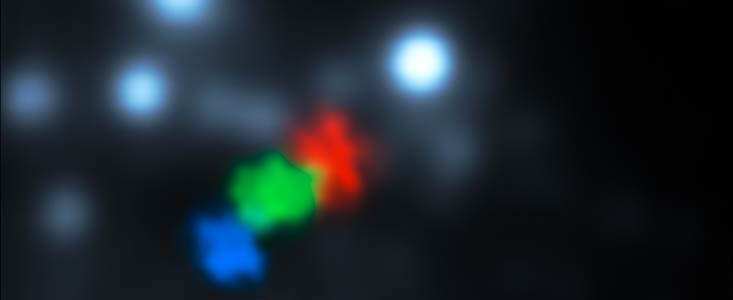
New observations from ESO’s Very Large Telescope show for the first time a gas cloud being ripped apart by the supermassive black hole at the centre of the galaxy. Shown here are VLT observations from 2006, 2010 and 2013, coloured blue, green and red respectively.  Credit: ESO/S. Gillessen
New observations from ESO’s Very Large Telescope show for the first time a gas cloud being ripped apart by the supermassive black hole at the centre of the galaxy. Shown here are VLT observations from 2006, 2010 and 2013, coloured blue, green and red respectively. Credit: ESO/S. Gillessen
If you thought all was reasonably quiet at the center of the Milky Way, you’d be wrong. Of course, you knew there was a black hole waiting… but did you know the ESO’s Very Large Telescope has seen a cloud of gas being ripped apart by its influence? Thanks to new observations, we’re able to see – in real time – a gaseous region so stretched that its leading edge has reached the event horizon and it’s retreating from the black hole at more than 10 million km/h while the trailing end is still falling inward!
Just two years ago, the VLT observed a gas cloud several times the mass of Earth making haste towards the Milky Way’s central black hole… an oblivion which dwarfs the cloud by about four million times. Right now the plucky cloud has reached its closest approach and “spaghettification” has began. The vaporous vagabond is being stretched out of proportion by the black hole’s gravitational field.
“The gas at the head of the cloud is now stretched over more than 160 billion kilometres around the closest point of the orbit to the black hole. And the closest approach is only a bit more than 25 billion kilometres from the black hole itself — barely escaping falling right in,” explains Stefan Gillessen (Max Planck Institute for Extraterrestrial Physics, Garching, Germany) who led the observing team. “The cloud is so stretched that the close approach is not a single event but rather a process that extends over a period of at least one year.”
At this point, the gas cloud is becoming so thin that its light is difficult to detect. However, by using the SINFONI instrument on the VLT, researchers took 20 hours of exposure time with the integral field spectrometer and were able to measure the velocity of various regions of the gas cloud as it blazes by the black hole.
“The most exciting thing we now see in the new observations is the head of the cloud coming back towards us at more than 10 million km/h along the orbit — about 1% of the speed of light,” adds Reinhard Genzel, leader of the research group that has been studied this region for nearly twenty years. “This means that the front end of the cloud has already made its closest approach to the black hole.”


Loading player...


Where the gas cloud originated is any one’s guess – but there are suggestions. Possibilities include jets from the galactic center, or stellar winds from orbiting stars. There may have once been a star in the center of the cloud, and the gas may have been a product of its winds or even a protoplanetary disk. In any circumstance, these new observations help to sort out the variety of possibilities.
“Like an unfortunate astronaut in a science fiction film, we see that the cloud is now being stretched so much that it resembles spaghetti. This means that it probably doesn’t have a star in it,” concludes Gillessen. “At the moment we think that the gas probably came from the stars we see orbiting the black hole.”
It’s an exciting time to be an astronomer. Through the “eyes” of the VLT, researchers the world over are able to watch a very unique event as it happens and not after the fact. ” This intense observing campaign will provide a wealth of data, not only revealing more about the gas cloud, but also probing the regions close to the black hole that have not been previously studied and the effects of super-strong gravity.”
As this drama at the heart of the Milky Way unfolds, astronomers are able to witness its many changes – “from purely gravitational and tidal to complex, turbulent hydrodynamics.”

Monday, July 15, 2013

Researcher Finds a New Moon Around Neptune in Hubble Data

Researcher Finds a New Moon Around Neptune in Hubble Data


This composite Hubble Space Telescope picture shows the location of a newly discovered moon, designated S/2004 N 1, orbiting the giant planet Neptune, nearly 4.8 billion km (3 billion miles) from Earth. Credit: NASA, ESA, and M. Showalter (SETI Institute).
It took sharp and patient eyes, but researcher Mark Showalter of the SETI Institute has found a tiny moon orbiting Neptune that’s never been seen before. Showalter used archival data from the Hubble Space Telescope to find the moon, designated S/2004 N 1, which is estimated to be no more than 19 km (12 miles) across, making it the smallest known moon in the Neptunian system. This is the 14th known moon of Neptune.

S/2004 N 1 is so small and dim that it is roughly 100 million times fainter than the faintest star that can be seen with the naked eye, NASA said. Even Voyager 2 –which flew past Neptune in 1989 to survey planet’s system of moons and rings – didn’t catch a view of this moon, even though data from Voyager 2 revealed several other moons.
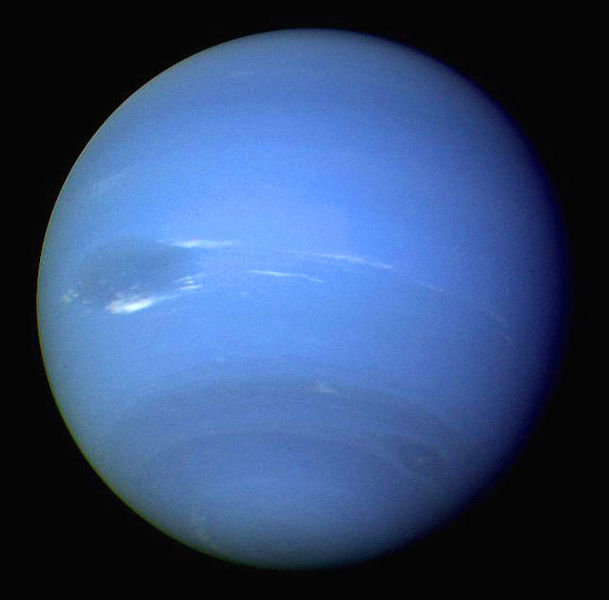
Neptune photographed by Voyage. Image credit: NASA/JPL
Neptune photographed by Voyager 2. Image credit: NASA/JPL
Showalter was studying the faint arcs, or segments of rings, around Neptune earlier this month.
“The moons and arcs orbit very quickly, so we had to devise a way to follow their motion in order to bring out the details of the system,” he said. “It’s the same reason a sports photographer tracks a running athlete — the athlete stays in focus, but the background blurs.”
The method involved tracking the movement of a white dot that appears over and over again in more than 150 archival Neptune photographs taken by Hubble from 2004 to 2009.
Showalter noticed the white dot about 1 million km (65,400 miles) from Neptune, located between the orbits of the Neptunian moons Larissa and Proteus. Showalter plotted a circular orbit for the moon, which completes one revolution around Neptune every 23 hours.
Showalter should get the “Eagle Eyes” award for 2013!
Source: HubbleSite

Sunday, July 14, 2013

Lawmakers propose Apollo Lunar Landing Legacy Act to open national park on the moon

Lawmakers propose Apollo Lunar Landing Legacy Act to open national park on the moon

Rep. Donna Edwards (D-Md.) and Eddie Bernice Johnson (D-Texas) want to see the country open a national park on the surface of the moon. They hope the Apollo Lunar Landing Legacy Act will protect gears left by there by astronauts from visitors.

0

JIM YOUNG/REUTERS

Rep. Donna Edwards (D-Md., third from right) is one of congresswomen proposing a national park of the moon.

WASHINGTON – Houston, we have a gift shop.
A pair of lawmakers are pushing a plan to establish a new national park that would be quite literally out of this world — a full 250,000 miles away from this world.
Rep. Donna Edwards (D-Md.) and Eddie Bernice Johnson (D-Texas) want the country to open its next national park on the surface of the moon.
The Apollo Lunar Landing Legacy Act would establish a national park on the surface of the moon.

MIKE SEGAR/REUTERS

The Apollo Lunar Landing Legacy Act would establish a national park on the surface of the moon.

The Apollo Lunar Landing Legacy Act establishing the galactic getaway “would ensure that the scientific data and cultural significance of the Apollo artifacts remain unharmed by future lunar landings,” Edwards said in a statement Tuesday.
RELATED: NASA DETAILS PLAN TO CAPTURE ASTEROID
The pair hope that a lunar national park would protect historical artifacts like gear left on the moon by seven lunar missions – six of which landed a dozen Americans on the moon between 1969 and 1972 — from an onslaught of foreign and private visitors in the years and decades to come.
Astronaut Eugene Cernan walks around the Apollo 17 landing site in 1972.

NASA/REUTERS

Astronaut Eugene Cernan walks around the Apollo 17 landing site in 1972.

Experts, however, say the bill may both duplicate and conflict with elements of the 1967 Outer Space Treaty, which the U.S. and Soviet Union signed off on at the height of the space race.
The treaty – joined by the Russian Federation and 100 other counties – establishes that all space objects remain property of the nation that launched them.
The treaty also bars any claim of national sovereignty on lunar territory – for park space or otherwise.
Astronaut and Lunar Module pilot Edwin (Buzz) Aldrin conducts Apollo 11 extravehicular activity in 1969.

HO/REUTERS

Astronaut and Lunar Module pilot Edwin (Buzz) Aldrin conducts Apollo 11 extravehicular activity in 1969.

RELATED: SUPERMOON RISES ON SUNDAY
In a nod to the treaty, Edwards’ bill limits the park’s components to the NASA equipment itself, but also defines the landing sites as “all areas of the Moon where astronauts and instruments connected to the Apollo program between 1969 and 1972 touched the lunar surface.”
That invokes astronauts’ precious lunar footprints, which may be tough to protect under the treaty.
Astronaut Edwin (Buzz) Aldrin beside the U.S. flag planted on the moon during the Apollo 11 mission in 1969.

NEIL ARMSTRONG/AP

Astronaut Edwin (Buzz) Aldrin beside the U.S. flag planted on the moon during the Apollo 11 mission in 1969.

James Dunstan, a veteran space lawyer and a fellow with the think tank TechFreedom noted that the last three Apollo missions deployed lunar rovers that covered “significant amounts of real estate.”
Joanne Gabrynowicz a Brooklyn native and director of the National Center for Remote Sensing, Air and Space Law at the University of Mississippi, said that under the treaty, “the fact that a lunar rover or other object has traversed lunar territory does not constitute a claim.”
Edwards’ bill would also require that the U.S, apply to the United Nations for designation of the Apollo 11 landing site – where Neil Armstrong and Buzz Aldrin first set foot on the moon July 20, 1969 – be designated a world heritage site.
Dunstan said that legislation simply asserting U.S. ownership of its equipment, and requiring the UN application “would receive a much warmer international reception.”


These Cubesats Could Use Plasma Thrusters to Leave Our Solar System

These Cubesats Could Use Plasma Thrusters to Leave Our Solar System


Artist concept of a 5 kg CubeSat with CubeSat Ambipolar Thruster (CAT) firing in low Earth orbit. Via Kickstarter.
Cubesats are all the rage these days: they’re usually inexpensive and quick to build and they can tag along on launches already scheduled for other things. We think of cubesats as being almost “disposable” satellites – tiny spacecraft that go into Earth orbit for a short time, do their science and then burn up harmlessly in Earth’s atmosphere. But a team of scientists have a more long-term, long-distance plan for their cubesats. Benjamin Longmier and James Cutler from the University of Michigan want to build cubesats that have tiny plasma thruster engines that could propel them into deep space, maybe even interstellar space.
They have a vision of their plasma-thruster cubesat waving as it speeds past the Voyager spacecraft at the edge of our Solar System.

They are working on what they call the CubeSat Ambipolar Thruster (CAT), a new plasma propulsion system. This thruster technology doesn’t exist all in one piece yet, but Longmeir and Cutler said they could put it together in months, with just a little funding. The CAT plasma thruster will propel a 5kg satellite into deep space, far beyond Earth orbit, at 1/1000th the cost of previous missions.
They’ve begun a $200,000 Kickstarter campaign to help fund their project. Their ideas of what these thruster propelled cubesats could do are mind-bogglingly exciting: flying through the plumes of Enceladus to look for life, studying and tagging asteroids, formation flying through Earth’s magnetosphere to learn more about solar flares and the aurora or just an interplanetary message in a bottle lasting for hundreds of millions of years in orbit around the Sun.


They think they can get a satellite up and flying within 18 months.
“The traditional funding process starts with some seed data, a large government grant and a large number of milestones and gates to go through,” said Longmier in a press release from the University of Michigan. “We’d like to leverage Kickstarter funds to compress that timeline and go from initial seed data to flight in about 18 months, a much faster time scale than is possible with traditional grants.”


 The cubesats would be about as big as a loaf of bread and the thrusters – the first of its kind — would use superheated plasma directed through a magnetic field to propel the CubeSat. The duo says that with this technology, exploring interplanetary space and eventually other planets would become faster and cheaper than ever before. While plasma rockets have been used before, they’ve only been used on big spacecraft like Deep Space 1 and DAWN. Longmier and Cutler are miniaturizing the system. Most of the thruster components have been built and have been tested individually, but they need help through Kickstarter to assemble everything into one compact thruster unit for testing the integrated components in the lab, then in Earth orbit, and then interplanetary space. They’ve got more info on how the thrusters work on their Kickstarter page. I dare you to tell me this isn’t exciting

Saturday, July 13, 2013

Jets Boost — Not Hinder — Star Formation in Early Galaxies, New Study Suggests

Jets Boost — Not Hinder — Star Formation in Early Galaxies, New Study Suggests


An artist's conception of jets protruding from an AGN.
An artist’s conception of jets protruding from an AGN. Image Credit: ESO
Understanding the formation of stars and galaxies early in the Universe’s history continues to be somewhat of an enigma, and a new study may have turned our current understanding on its head. A recent survey used archival data from four different telescopes to analyze hundreds of galaxies. The results provided overwhelming evidence that radio jets protruding from a galactic center enhance star formation – a result that directly contradicts current models, where star formation is hindered or even stopped.
Remove this ad

All early galaxies consist of intensely luminous cores powered by huge black holes.  These so-called active galactic nuclei, or AGN for short, are still the topic of intense study. One specific mechanism astronomers are studying is known as AGN feedback.
“Feedback is the astronomer’s slang term for the way in which an AGN – with its large amount of energy release – influences its host galaxy,” Dr. Zinn, lead researcher on this study, recently told Universe Today. He explained there is both positive feedback, in which the AGN will foster the main activity of the galaxy: star formation, and negative feedback, in which the AGN will hinder or even stop star formation.
Current simulations of galaxy growth invoke strong negative feedback.
“In most cosmological simulations, AGN feedback is used to truncate star formation in the host galaxy,” said Zinn. “This is necessary to prevent the simulated galaxies from becoming too bright/massive.”
Zinn et al. found strong evidence that this is not the case for a large number of early galaxies, claiming that the presence of an AGN actually enhances star formation. In such cases the total star formation rate of a galaxy may be boosted by a factor of 2 – 5.
Furthermore the team showed that positive feedback occurs in radio-luminous AGN. There is strong correlation between the far infrared (indicative of star formation) and the radio.
Now, a correlation between the radio and the far infrared is no stranger to galactic astronomy. Stars form in extremely dusty regions. This dust absorbs the starlight and re-emits it in the far infrared. The stars then die in huge supernova explosions, causing powerful shock-fronts, which accelerate electrons and lead to the emission of strong synchrotron radiation in the radio.
This correlation however is a stranger to AGN studies. The key lies in the radio jets, which penetrate far into the host galaxy itself.  A “jet which is launched from the AGN hits the interstellar gas of the host galaxy and thereby induces supersonic shocks and turbulence,” explains Zinn. “This shortens the clumping time of gas so that it can condense into stars much more quick and efficiently.”
This new finding conveys that the exact mechanisms in which AGN interact with their host galaxies is much more complicated than previously thought. Future observations will likely shed a new understanding of the evolution of galaxies.

The team used data primarily from the Chandra Deep Field South image
but also data from Hubble, Herschel and Spitzer.
The results will be published in the Astrophysical Journal (preprint available here).

Thursday, July 11, 2013

"Stephen Hawking's Grand Design" The Meaning of Life

"Stephen Hawking's Grand Design" The Meaning of Life


Freelance Jobs


Hawking tackles the question: Is there a meaning to life? Is there a purpose to our existence? Hawking explores this fascinating territory with fearless zeal as he questions the very nature of reality. You'll never look at yourself the same way again.

-->
Lazada 468x60 2
Lazada 300x250 1

60 Billion Habitable Planets in the Milky Way Alone?

60 Billion Habitable Planets in the Milky Way Alone? Astronomers say Yes!

An artist's conception of how common exoplanets are throughout the Milky Way Galaxy. Image Credit: Wikipedia
An artist’s conception of how common exoplanets are throughout the Milky Way Galaxy. Image Credit: Wikipedia
Lazada 468x60 2
A new study suggests that the number of habitable exoplanets within the Milky Way alone may reach 60 billion.
Previous research performed by a team at Harvard University suggested that there is one Earth-sized planet in the habitable zone of each red dwarf star. But researchers at the University of Chicago and Northwestern University have now extended the habitable zone and doubled this estimate.

The research team, lead by Dr. Jun Yang considered one more variable in their calculations: cloud cover. Most exoplanets are tidally locked to their host stars – one hemisphere continually faces the star, while one continuously faces away. These tidally locked planets have a permanent dayside and a permanent nightside.
One would expect the temperature gradient between the two to be very high, as the dayside is continuously receiving stellar flux, while the nightside is always in darkness. Computer simulations that take into account cloud cover show that this is not the case.
The dayside is covered by clouds, which lead to a “stabilizing cloud feedback” on climate.  It has a higher cloud albedo (more light is reflected off the clouds) and a lower greenhouse effect. The presence of clouds actually causes the dayside to be much cooler than expected.
“Tidally locked planets have low enough surface temperatures to be habitable,” explains Jang in his recently published paper. Cloud cover is so effective it even extends the habitable zone to twice the stellar flux. Planets twice as close to their host star are still cool enough to be habitable.
But these new statistics do not apply to just a few stars. Red dwarfs “represent about ¾ of the stars in the galaxy, so it applies to a huge number of planets,” Dr. Abbot, co-author on the paper, told Universe Today. It doubles the number of planets previously thought habitable throughout the entire galaxy.
Not only is the habitable zone around red dwarfs much larger, red dwarfs also live for much longer periods of time. In fact, the Universe is not old enough for any of these long-living stars to have died yet. This gives life the amount of time necessary to form. After all, it took human beings 4.5 billions years to appear on Earth.
Another study we reported on earlier also revised and extrapolated the habitable zone around red dwarf stars.
Future observations will verify this model by measuring the cloud temperatures. On the dayside, we will only be able to see the high cool clouds. A planet resembling this model will therefore look very cold on the dayside. In fact, “a planet that does show the cloud feedback will look hotter on the nightside than the dayside,” explains Abbot.
This effect will be testable with the James Webb Space Telescope.  All in all, the Milky Way is likely to be teeming with life.
Freelance Jobs-->

Monday, July 8, 2013

Shuttle Atlantis Soars In New Exhibit, Two Years After Last Space Launch

Shuttle Atlantis Soars In New Exhibit, Two Years After Last Space Launch

The belly of space shuttle Atlantis in the new exhibit at the Kennedy Space Center. Credit: Steven Coates
Two years after space shuttle Atlantis launched into space, it’s still looking like it returned from a long journey. It “bears the scars, scorch marks and space dust of its last mission,” writes the Kennedy Space Center Visitors’ Center.
That’s deliberate, though. In late June, visitors to the Orlando-area attraction got the chance to get nose-to-nose with this orbiter in a new exhibit. Atlantis, unlike similar exhibits of other shuttles so far, is perched on a precise 43.21-degree angle to give a view previously afforded only to astronauts.

The $100 million, 90,000-square-foot exhibit also has an International Space Station gallery, a simulated shuttle launch ride, and training simulators for landing, space station docking and moving the robotic Canadarm.
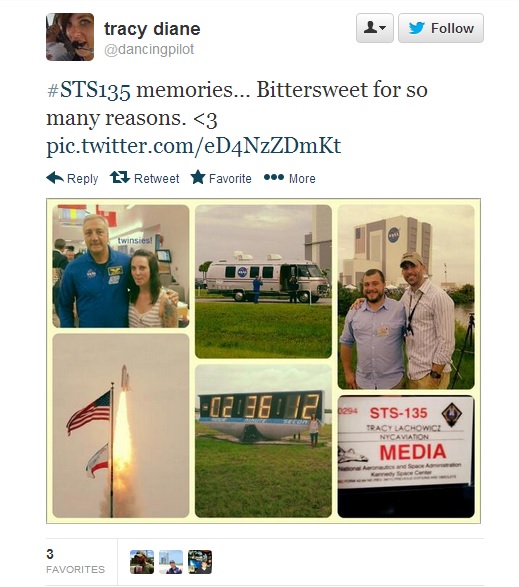
Today (July 8) marked the two-year launch anniversary of STS-135, the last journey of both Atlantis and the shuttle program. Its main goal was to haul a huge load of supplies and spare parts to the space station. The event also generated a NASA Social, which many of the participants (including Universe Today‘s Jason Major) recalled today:
bittersweet_sts135
For those of us who couldn’t make the launch in person, luckily there’s plenty of multimedia material out there to experience it virtually. Universe Today‘s Ken Kramer was also at the final launch, and posted some photos on our website . NASA has a hub commemorating the last shuttle launch. NASA Kennedy published a mission tribute video, including some rarer footage.
And of course, you can watch the launch itself in many videos, including this official one from NASA below.
What are your favorite memories of Atlantis activities, either from attending launches or doing other things? Feel free to share in the comments.

Faces And Animals On Mars? Pure Pareidolia!

Faces And Animals On Mars? Pure Pareidolia!


Seeing familiar shapes in clouds is easy especially when you've got a handy reference. Credit: Andrew Kirk
Seeing familiar shapes in clouds is easy especially when you’ve got a handy reference. Credit: Andrew Kirk
As kids, my friends and I would stare at clouds on lazy summer afternoons and point out faces and animals we saw in their folds and domes. When the light was right, some of them looked as detailed and real as if chiseled by a meteorological Michelangelo. Later, with kids of our own, we often revisit this simple pleasure.


image of the "Virgin Mary" appears in the glass of a Tampa, Florida office building on Christmas Day 1996. Credit: Wikipedia
image of the “Virgin Mary” appears in the glass of a Tampa, Florida office building on Christmas Day 1996. Credit: Wikipedia
Patterns can materialize anywhere – old men with scraggly beards in carpeting, blocky visages in road cuts and even Jesus on toast. Here are 50 more fun examples. Our instinctive ability to find patterns in the often random mish-mash of nature is called pareidolia (pair-eye-DOLE-ya).
The late planetary scientist and astronomy popularizer Carl Sagan believed pattern-recognition was part of our evolutionary heritage:
“As soon as the infant can see, it recognizes faces, and we now know that this skill is hardwired in our brains,” wrote Sagan. “Those infants who a million years ago were unable to recognize a face smiled back less, were less likely to win the hearts of their parents, and less likely to prosper.”
Maybe it’s simpler than that. Face-recognition is critical because we ultimately need each other for survival not to mention keeping track of the kids in the grocery store. Pattern recognition also helped us find food back in the days of hunting and gathering. The ability to distinguish a particular plant or animal against the background noise meant the difference between a full belly or starvation.
The infamous Mars Face (left) photographed in comparatively low resolution by the Viking orbiter in 1976 and a much higher resolution view made by current Mars Reconnaissance Orbiter. Credit: NASA
Pareidolia also works its magic across the cosmos. To narrow the scope, I’ve selected images taken of Mars, the most fertile planet for imaginary faces around. Who doesn’t remember all the hubbub over the “Face of Mars”? Old Viking spacecraft images from the mid-1970s taken at low resolution in slanted lighting seemed to show a face carved of rock staring back at Earth.
Since pareidolia works best when the stimulus is vague or the object unclear the “face” was perfect. Our brains are more than happy to fill in fictional details. Later photos taken at much lower altitude with higher resolution cameras made the face disappear; in its place we clearly see an eroded mesa. Then there’s the so-called “Bigfoot on Mars,” (an extremely very tiny Bigfoot) and later someone zoomed in on a small rock and said there was a gorilla on Mars. Information equals identity, lack of detail opens the door to anything we might imagine.
Here are 10 examples of imaginary faces and creatures on Mars. The inspiration to write about the topic came from a series of recent “art” images taken with the THEMIS camera on board the Mars Odyssey spacecraft. The probe orbits Mars every 2 hours and carries three science instruments; the camera combines images shot in 5 wavelengths or colors of visual light and 9 in the infrared or heat-emitting part of the spectrum. Others were snapped by the Mars Reconnaissance Orbiter. All are NASA images, and I’ve taken the liberty to colorize several of the black and whites to approximate the appearance of the color images.
Enjoy!

1. My Happy Martian
Those Martians obviously have a sense of humor. This 2-mile-wide (3 km) unnamed crater was photographed in 2008 by the Mars Reconnaissance Orbiter.
Martians obviously have a sense of humor. This 2-mile-wide (3 km) unnamed crater was photographed in 2008 by the Mars Reconnaissance Orbiter.
2. That Buzzing Sound
This crater chain with its wispy "wings" of impact debris resembles a wasp. The feature was most likely created when a meteorite coming it at a very low angle broke into pieces just before impact.
This crater chain with its wispy “wings” of impact debris resembles a wasp. The feature was most likely created when a meteorite arriving it at a very low angle broke into pieces just before impact.
3. The Mammoth Still Lives
Lava flows in Mars' Elysium Planitia region have left a rather good likeness of a woolly mammoth or elephant. The region is known for some of the planet's youngest lavas - this one may formed in the past 100 million years.
Lava flows in Mars’ Elysium Planitia region have left a rather good likeness of a woolly mammoth or elephant. The region is known for some of the planet’s youngest lavas – this one may have formed as recently as the past 100 million years.
4. Have A Heart (or two)
I love these two little hearts. The one on the left is a mesa top outlined by frost about the size of a football stadium. On the right, a small impact crater near the tip of the heart blew away dark surface material exposing lighter soil beneath. Some of the material appears to have flowed downslope to create the heart.
5. Rare Sighting Of A Dust-Covered Hummingbird
5. Rare sighting of the dust-coated hummingbird
The head and long beak of a hummingbird is easy to imagine in this scene. I can’t say for sure how these features formed but wind and erosion no doubt played a part.
6. Hitchcockian Horror
A Martian bird of prey? Watch out, that beak looks sharp!
Martian bird of prey or just another wayward pigeon?
7. Get It In Gear
The eroded blankets of ejecta blasted out when these craters formed look like a series of interlocking gears.
 8. Lone Wolf On The Martian Prairie
Dark sand dune deposits look eerily like a howling wolf.
9. Thumbs Up!
These dunes remind me of a Minnesota “Thank you” for jump starting your car on a cold winter morning.
10. To A “T”
Tectonic stretching of the Martian crust created this unusual right-angle fracture. I wonder how many other letters of the alphabet we might find on the Red Planet?

Sunday, July 7, 2013

Is There A Creator?


Is There A Creator?

Through The Wormhole – Is There A Creator?It’s perhaps the biggest, most controversial mystery in the cosmos. Did our Universe just come into being by random chance, or was it created by a God who nurtures and sustains all life?
The latest science is showing that the four forces governing our universe are phenomenally finely tuned. So finely that it had led many to the conclusion that someone, or something, must have calibrated them; a belief further backed up by evidence that everything in our universe may emanate from one extraordinarily elegant and beautiful design known as the E8 Lie Group.
While skeptics hold that these findings are neither conclusive nor evidence of a divine creator, some cutting edge physicists are already positing who this God is: an alien gamester who’s created our world as the ultimate SIM game for his own amusement. It’s an answer as compelling as it is disconcerting.
This is the first episode.


See the list of all episodes here: Through The Wormhole.


Astronomy Calendar of Celestial Events for Calendar Year 2013

    • January 11 - New Moon. The Moon will be directly between the Earth and the Sun and will not be visible from Earth. This phase occurs at 19:44 UTC. This is the best time of the month to observe faint objects such as galaxies and star clusters because there is no moonlight to interfere.
    • January 27 - Full Moon. The Moon will be directly opposite the Earth from the Sun and will be fully illuminated as seen from Earth. This phase occurs at 04:38 UTC. This full moon was known by early Native American tribes as the Full Wolf Moon because this was the time of year when hungry wolf packs howled outside their camps. This moon has also been know as the Old Moon and the Moon After Yule.
    • February 10 - New Moon. The Moon will be directly between the Earth and the Sun and will not be visible from Earth. This phase occurs at 07:20 UTC. This is the best time of the month to observe faint objects such as galaxies and star clusters because there is no moonlight to interfere.
    • February 16 - Mercury at Greatest Eastern Elongation. The planet Mercury will be at its furthest angle from the Sun, known as greatest elongation. It will be at its highest point in the night sky after sunset. This is the best time to try to view Mercury since it stays so close to the Sun and doesn't usually climb very high above the horizon.
    • February 18 - Conjunction of the Moon and Jupiter. The Moon will pass less than one degree from the giant planet Jupiter in the evening sky. The first quarter moon will be at magnitude -11.9 and Jupiter will be at magnitude -2.4. Look for both objects in the west after sunset. The pair will be visible in the evening sky for about 7 hours after sunset.
    • February 25 - Full Moon. The Moon will be directly opposite the Earth from the Sun and will be fully illuminated as seen from Earth. This phase occurs at 20:26 UTC. This full moon was known by early Native American tribes as the Full Snow Moon because the heaviest snows usually fell during this time of the year. Since hunting is difficult, this moon has also been known by some tribes as the Full Hunger Moon.
    • March 10 - Comet Pan-STARRS Closest Approach to the Sun. Newly discovered comet Pan-STARRS will make its closest approach to the Sun on March 10. The comet will start to be visible in the morning sky in early February in the Southern Hemisphere. It will gradually increase in brightness until its encounter with the Sun on March 10. By this time it will be visible in the evening sky in the Northern Hemisphere. It can be seen just to the left of the setting sun. It will continue to be visible in the evening sky for the rest of March and into early April.
    • March 11 - New Moon. The Moon will be directly between the Earth and the Sun and will not be visible from Earth. This phase occurs at 19:51 UTC. This is the best time of the month to observe faint objects such as galaxies and star clusters because there is no moonlight to interfere.
    • March 17 - Conjunction of the Moon and Jupiter. The Moon will pass about one and a half degrees of the giant planet Jupiter in the evening sky. The first quarter moon will be at magnitude -11.4 and Jupiter will be at magnitude -2.2. Look for both objects in the west after sunset. The pair will be visible in the evening sky for about 5 hours after sunset.
    • March 20 - March Equinox. The March equinox occurs at 11:02 UTC. The Sun will shine directly on the equator and there will be nearly equal amounts of day and night throughout the world. This is also the first day of spring (vernal equinox) in the Northern Hemisphere and the first day of fall (autumnal equinox) in the Southern Hemisphere.
    • March 27 - Full Moon. The Moon will be directly opposite the Earth from the Sun and will be fully illuminated as seen from Earth. This phase occurs at 09:27 UTC. This full moon was known by early Native American tribes as the Full Worm Moon because this was the time of year when the ground would begin to soften and the earthworms would reappear. This moon has also been known as the Full Crow Moon, the Full Crust Moon, and the Full Sap Moon.
    • April 10 - New Moon. The Moon will be directly between the Earth and the Sun and will not be visible from Earth. This phase occurs at 09:35 UTC. This is the best time of the month to observe faint objects such as galaxies and star clusters because there is no moonlight to interfere.
    • April 14 - Conjunction of the Moon and Jupiter. The Moon will pass about two degrees of the giant planet Jupiter in the evening sky. The crescent moon will be at magnitude -10.6 and Jupiter will be at magnitude -2.1. Look for both objects in the west after sunset. The pair will be visible in the evening sky for about 3 hours after sunset.
    • April 20 - Astronomy Day Part 1. Astronomy Day is an annual event intended to provide a means of interaction between the general public and various astronomy enthusiasts, groups and professionals. The theme of Astronomy Day is "Bringing Astronomy to the People," and on this day astronomy and stargazing clubs and other organizations around the world will plan special events. You can find out about special local events by contacting your local astronomy club or planetarium. You can also find more about Astronomy Day by checking the Web site for the Astronomical League.
    • April 21, 22 - Lyrids Meteor Shower. The Lyrids is an average shower, usually producing about 20 meteors per hour at its peak. It is produced by dust particles left behind by comet C/1861 G1 Thatcher, which was discovered in 1861. The shower runs annually from April 16-25. It peaks this year on the night of the night of the 21st and morning of the 22nd. These meteors can sometimes produce bright dust trails that last for several seconds. The nearly full moon will be a problem this year, blocking out all but the brightest meteors. Best viewing will be from a dark location after midnight. Meteors will radiate from the constellation Lyra, but can appear anywhere in the sky.
    • April 25 - Full Moon. The Moon will be directly opposite the Earth from the Sun and will be fully illuminated as seen from Earth. This phase occurs at 19:57 UTC. This full moon was known by early Native American tribes as the Full Pink Moon because it marked the appearance of the moss pink, or wild ground phlox, which is one of the first spring flowers. This year, it is also known as the Paschal Full Moon because it is the first full moon of the spring season.
    • April 25 - Partial Lunar Eclipse. A partial lunar eclipse occurs when the Moon passes through the Earth's partial shadow, or penumbra, and only a portion of it passes through the darkest shadow, or umbra. During this type of eclipse a part of the Moon will darken as it moves through the Earth's shadow. The eclipse will be visible throughout most of Africa, Europe, Asia, and Australia. (NASA Map and Eclipse Information)
    • April 28 - Saturn at Opposition. The ringed planet will be at its closest approach to Earth and its face will be fully illuminated by the Sun. This is the best time to view and photograph Saturn and its moons. A medium-sized or larger telescope will allow you to see Saturn's rings and a few of its brightest moons.
    • May 4, 5 - Eta Aquarids Meteor Shower. The Eta Aquarids is an above average shower, capable of producing up to 60 meteors per hour at its peak. Most of the activity is seen in the Southern Hemisphere. In the Northern Hemisphere, the rate can reach about 30 meteors per hour. It is produced by dust particles left behind by comet Halley, which has known and observed since ancient times. The shower runs annually from April 19 to May 28. It peaks this year on the night of May 4 and the morning of the May 5. The second quarter moon will block out some of the less bright meteors this year but you should still be able to see quite a few good ones if you are patient. Best viewing will be from a dark location after midnight. Meteors will radiate from the constellation Aquarius, but can appear anywhere in the sky.
    • May 10 - New Moon. The Moon will be directly between the Earth and the Sun and will not be visible from Earth. This phase occurs at 00:28 UTC. This is the best time of the month to observe faint objects such as galaxies and star clusters because there is no moonlight to interfere.
    • May 10 - Annular Solar Eclipse. An annular solar eclipse occurs when the Moon is too far away from the Earth to completely cover the Sun. This results in a ring of light around the darkened Moon. The Sun's corona is not visible during an annular eclipse. The path of the eclipse will begin in western Australia and move east across the central Pacific Ocean. (NASA Map and Eclipse Information)
    • May 25 - Full Moon. The Moon will be directly opposite the Earth from the Sun and will be fully illuminated as seen from Earth. This phase occurs at 04:25 UTC. This phase occurs at 11:09 UTC. This full moon was known by early Native American tribes as the Full Flower Moon because this was the time of year when spring flowers appeared in abundance. This moon has also been known as the Full Corn Planting Moon and the Milk Moon.
    • May 25 - Penumbral Lunar Eclipse. A penumbral lunar eclipse occurs when the Moon passes through the Earth's partial shadow, or penumbra. During this type of eclipse the Moon will darken slightly but not completely. The eclipse will be visible throughout most of North America, South America, western Europe, and western Africa. (NASA Map and Eclipse Information)
    • May 28 - Conjunction of Venus and Jupiter. Conjunctions are rare events where two or more objects will appear extremely close together in the night sky. The two bright planets will be within 1 degree of each other in the evening sky. The planet Mercury will also will also be visible nearby. Look to the west near sunset.
    • June 8 - New Moon. The Moon will be directly between the Earth and the Sun and will not be visible from Earth. This phase occurs at 15:56 UTC. This is the best time of the month to observe faint objects such as galaxies and star clusters because there is no moonlight to interfere.
    • June 12 - Mercury at Greatest Eastern Elongation. The planet Mercury will be at its furthest angle from the Sun, known as greatest elongation. It will be at its highest point in the night sky after sunset. This is the best time to try to view Mercury since it stays so close to the Sun and doesn't usually climb very high above the horizon.
    • June 21 - June Solstice. The June solstice occurs at 05:04 UTC. The North Pole of the earth will be tilted toward the Sun, which will have reached its northernmost position in the sky and will be directly over the Tropic of Cancer at 23.44 degrees north latitude. This is the first day of summer (summer solstice) in the Northern Hemisphere and the first day of winter (winter solstice) in the Southern Hemisphere.
    • June 23 - Full Moon. The Moon will be directly opposite the Earth from the Sun and will be fully illuminated as seen from Earth. This phase occurs at 11:32 UTC. This full moon was known by early Native American tribes as the Full Strawberry Moon because it signaled the time of year to gather ripening fruit. It also coincides with the peak of the strawberry harvesting season. This moon has also been known as the Full Rose Moon and the Full Honey Moon.
    • July 8 - New Moon. The Moon will be directly between the Earth and the Sun and will not be visible from Earth. This phase occurs at 07:14 UTC. This is the best time of the month to observe faint objects such as galaxies and star clusters because there is no moonlight to interfere.
    • July 22 - Full Moon. The Moon will be directly opposite the Earth from the Sun and will be fully illuminated as seen from Earth. This phase occurs at 18:15 UTC. This full moon was known by early Native American tribes as the Full Buck Moon because the male buck deer would begin to grow their new antlers at this time of year. This moon has also been known as the Full Thunder Moon and the Full Hay Moon.
    • July 27, 28 - Delta Aquarids Meteor Shower. The Delta Aquarids is an average shower that can produce up to 20 meteors per hour at its peak. It is produced by debris left behind by comets Marsden and Kracht. The shower runs annually from July 12 to August 23. It peaks this year on the night of July 27 and morning of July 28. The second quarter moon will block out most of the faint meteors, but you should still be able to catch quite a few good ones if you are patient. Best viewing will be from a dark location after midnight. Meteors will radiate from the constellation Aquarius, but can appear anywhere in the sky.
    • August 6 - New Moon. The Moon will be directly between the Earth and the Sun and will not be visible from Earth. This phase occurs at 21:51 UTC. This is the best time of the month to observe faint objects such as galaxies and star clusters because there is no moonlight to interfere.
    • August 11, 12 - Perseids Meteor Shower. The Perseids is one of the best meteor showers to observe, producing up to 60 meteors per hour at its peak. It is produced by comet Swift-Tuttle, which was discovered in 1862. The Perseids are famous for producing a large number of bright meteors. The shower runs annually from July 17 to August 24. It peaks this year on the night of August 11 and the morning of August 12. The first quarter moon will set shortly after midnight leaving dark skies for what should be an excellent show. Best viewing will be from a dark location after midnight. Meteors will radiate from the constellation Perseus, but can appear anywhere in the sky.
    • August 21 - Full Moon. The Moon will be directly opposite the Earth from the Sun and will be fully illuminated as seen from Earth. This phase occurs at 01:45 UTC. This full moon was known by early Native American tribes as the Full Sturgeon Moon because the large sturgeon fish of the Great Lakes and other major lakes were more easily caught at this time of year. This moon has also been known as the Green Corn Moon and the Grain Moon.
    • August 27 - Neptune at Opposition. The blue giant planet will be at its closest approach to Earth and its face will be fully illuminated by the Sun. This is the best time to view and photograph Neptune. Due to its extreme distance from Earth, it will only appear as a tiny blue dot in all but the most powerful telescopes.
    • September 5 - New Moon. The Moon will be directly between the Earth and the Sun and will not be visible from Earth. This phase occurs at 11:36 UTC. This is the best time of the month to observe faint objects such as galaxies and star clusters because there is no moonlight to interfere.
    • September 8 - Conjunction of the Moon and Venus. The Moon will pass within about a half of a degree from the the planet Venus in the early evening sky. The thin crescent moon will be at magnitude -10.4 and Venus will be at magnitude -4.5. Look for both objects low in the western sky in the early evening. The pair will be visible in the evening sky for about 2 hours after sunset.
    • September 8 - Conjunction of the Venus and Saturn. The two planets 3 degrees of each other in the early evening sky. Venus will be at magnitude -4.6 and Saturn will be at magnitude -1.1. Look for both objects low in the western sky in the early evening. The pair will be visible in the evening sky for about 2 hours after sunset.
    • September 19 - Full Moon. The Moon will be directly opposite the Earth from the Sun and will be fully illuminated as seen from Earth. This phase occurs at 11:13 UTC. This full moon was known by early Native American tribes as the Full Corn Moon because the corn is harvested around this time of year. This moon is also known as the Harvest Moon. The Harvest Moon is the full moon that occurs closest to the September equinox each year.
    • September 22 - September Equinox. The September equinox occurs at 20:44 UTC. The Sun will shine directly on the equator and there will be nearly equal amounts of day and night throughout the world. This is also the first day of fall (autumnal equinox) in the Northern Hemisphere and the first day of spring (vernal equinox) in the Southern Hemisphere.
    • October 3 - Uranus at Opposition. The blue-green planet will be at its closest approach to Earth and its face will be fully illuminated by the Sun. This is the best time to view Uranus. Due to its distance, it will only appear as a tiny blue-green dot in all but the most powerful telescopes.
    • October 5 - New Moon. The Moon will be directly between the Earth and the Sun and will not be visible from Earth. This phase occurs at 00:34 UTC. This is the best time of the month to observe faint objects such as galaxies and star clusters because there is no moonlight to interfere.
    • October 7, 8 - Draconids Meteor Shower. The Draconids is a minor meteor shower producing only about 10 meteors per hour. It is produced by dust grains left behind by comet 21P Giacobini-Zinner, which was first discovered in 1900. The shower runs annually from October 6-10 and peaks this year on the the night of the 7th and morning of the 8th. The thin crescent moon will set early in the evening leaving dark skies for optimal observing. Best viewing will be just after midnight from a dark location far away from city lights. Meteors will radiate from the constellation Draco, but can appear anywhere in the sky.
    • October 9 - Mercury at Greatest Eastern Elongation. The planet Mercury will be at its furthest angle from the Sun, known as greatest elongation. It will be at its highest point in the night sky after sunset. This is the best time to try to view Mercury since it stays so close to the Sun and doesn't usually climb very high above the horizon.
    • October 12 - Astronomy Day Part 2. Astronomy Day is an annual event intended to provide a means of interaction between the general public and various astronomy enthusiasts, groups and professionals. The theme of Astronomy Day is "Bringing Astronomy to the People," and on this day astronomy and stargazing clubs and other organizations around the world will plan special events. You can find out about special local events by contacting your local astronomy club or planetarium. You can also find more about Astronomy Day by checking the Web site for the Astronomical League.
    • October 12 - International Observe the Moon Night. International Observe the Moon Night (InOMN) is an annual event that is dedicated to encouraging people to ‘look up’ and take notice of our nearest neighbor, the Moon. From looking at the Moon with a naked eye to using the most sensitive telescope, every year on the same day, people from around the world hold events and activities that celebrate our Moon. On this site, you can find information about an InOMN event near you or register your own event. We encourage everyone to join us in the celebration! International Observe the Moon Night Official Site.
    • October 18 - Full Moon. The Moon will be directly opposite the Earth from the Sun and will be fully illuminated as seen from Earth. This phase occurs at 23:38 UTC. This full moon was known by early Native American tribes as the Full Hunters Moon because at this time of year the leaves are falling and the game is fat and ready to hunt. This moon has also been known as the Travel Moon and the Blood Moon. This will also be the smallest full moon of the year because it will be near apogee, its farthest point from the Earth.
    • October 18 - Penumbral Lunar Eclipse. A penumbral lunar eclipse occurs when the Moon passes through the Earth's partial shadow, or penumbra. During this type of eclipse the Moon will darken slightly but not completely. The eclipse will be visible throughout most of the world except for Australia and extreme eastern Siberia.
      (NASA Map and Eclipse Information)
    • October 21, 22 - Orionids Meteor Shower. The Orionids is an average shower producing up to 20 meteors per hour at its peak. It is produced by dust grains left behind by comet Halley, which has been known and observed since ancient times. The shower runs annually from October 2 to November 7. It peaks this year on the night of October 21 and the morning of October 22. The waning gibbous moon will block some of the meteors this year, but the Orionids tend to be fairly bright so it could still be a good show. Best viewing will be from a dark location after midnight. Meteors will radiate from the constellation Orion, but can appear anywhere in the sky.
    • November 3 - New Moon. The Moon will be directly between the Earth and the Sun and will not be visible from Earth. This phase occurs at 12:50 UTC. This is the best time of the month to observe faint objects such as galaxies and star clusters because there is no moonlight to interfere.
    • November 3 - Hybrid Solar Eclipse. A hybrid solar eclipse occurs when the Moon is almost too close to the Earth to completely block the Sun. This type of eclipse will appear as a total eclipse to some parts of the world and will appear annular to others. The eclipse path will begin in the Atlantic Ocean off the eastern coast of the United States and move east across the Atlantic and across central Africa. (NASA Map and Eclipse Information)
    • November 4, 5 - Taurids Meteor Shower. The Taurids is a long-running minor meteor shower producing only about 5-10 meteors per hour. It is unusual in that it consists of two separate streams. The first is produced by dust grains from Asteroid 2004 TG10. The second stream is produced by debris left behind by Comet 2P Encke. The shower runs annually from September 7 to December 10. It peaks this year on the the night of November 4. This is an excellent year because there will be no moonlight to spoil the show. Best viewing will be just after midnight from a dark location far away from city lights. Meteors will radiate from the constellation Taurus, but can appear anywhere in the sky.
    • November 17 - Full Moon. The Moon will be directly opposite the Earth from the Sun and will be fully illuminated as seen from Earth. This phase occurs at 15:16 UTC. This full moon was known by early Native American tribes as the Full Beaver Moon because this was the time of year to set the beaver traps before the swamps and rivers froze. It has also been known as the Frosty Moon and the Hunter's Moon.
    • November 16, 17 - Leonids Meteor Shower. The Leonids is an average shower, producing an average of up to 15 meteors per hour at its peak. This shower is unique in that it has a cyclonic peak about every 33 years where hundreds of meteors per hour can be seen. That last of these occurred in 2001. The Leonids is produced by dust grains left behind by comet Tempel-Tuttle, which was discovered in 1865. The shower runs annually from November 6-30. It peaks this year on the night of the 16th and morning of the 17th. Unfortunately the glare from the full moon will block many of the meteors this year, but if you are patient you should still be able to catch quite a few good ones. Best viewing will be from a dark location after midnight. Meteors will radiate from the constellation Leo, but can appear anywhere in the sky.
    • November 28 - Comet ISON Closest Approach to the Sun. Newly discovered comet ISON will make its closest approach to the Sun on November 28. If the comet survives its encounter with the Sun, it could be one of the brightest comets in recent memory. Some astronomers estimate that it could even be bright enough to be seen during daylight hours. In August and September, the comet will begin to be visible in the morning sky in dark locations with telescopes. In October it will start to be visible to the naked eye and will continue to get brighter until November 28. If the comet survives, it will be visible in the early morning and early evening sky and could be nearly as bright as the full Moon. Some astronomers are already calling it the comet of the century.
    • December 3 - New Moon. The Moon will be directly between the Earth and the Sun and will not be visible from Earth. This phase occurs at 00:22 UTC. This is the best time of the month to observe faint objects such as galaxies and star clusters because there is no moonlight to interfere.
    • December 13, 14 - Geminids Meteor Shower. The Geminids is the king of the meteor showers. It is considered by many to be the best shower in the heavens, producing up to 120 multicolored meteors per hour at its peak. It is produced by debris left behind by an asteroid known as 3200 Phaethon, which was discovered in 1982. The shower runs annually from December 7-17. It peaks this year on the night of the 13th and morning of the 14th. The waxing gibbous moon will block out some of the meteors this year, but the Geminids are so bright and numerous that it should still be a good show. Best viewing will be from a dark location after midnight. Meteors will radiate from the constellation Gemini, but can appear anywhere in the sky.
    • December 17 - Full Moon. The Moon will be directly opposite the Earth from the Sun and will be fully illuminated as seen from Earth. This phase occurs at 09:28 UTC. This full moon was known by early Native American tribes as the Full Cold Moon because this is the time of year when the cold winter air settles in and the nights become long and dark. This moon has also been known as the Moon Before Yule and the Full Long Nights Moon.
    • December 21 - December Solstice. The December solstice occurs at 17:11 UTC. The South Pole of the earth will be tilted toward the Sun, which will have reached its southernmost position in the sky and will be directly over the Tropic of Capricorn at 23.44 degrees south latitude. This is the first day of winter (winter solstice) in the Northern Hemisphere and the first day of summer (summer solstice) in the Southern Hemisphere.
    • December 21, 22 - Ursids Meteor Shower. The Ursids is a minor meteor shower producing only about 5-10 meteors per hour. It is produced by dust grains left behind by comet Tuttle, which was first discovered in 1790. The shower runs annually from December 17-25. It peaks this year on the the night of the 21st. This year the second quarter moon will be bright enough to hide all but the brightest meteors. If you are patient, you might still be able to catch a few good ones. Best viewing will be just after midnight from a dark location far away from city lights. Meteors will radiate from the constellation Ursa Minor, but can appear anywhere in the sky.

Nova link

    Powered by Traffic Nova