
Researcher Finds a New Moon Around Neptune in Hubble Data

This
composite Hubble Space Telescope picture shows the location of a newly
discovered moon, designated S/2004 N 1, orbiting the giant planet
Neptune, nearly 4.8 billion km (3 billion miles) from Earth. Credit:
NASA, ESA, and M. Showalter (SETI Institute).
S/2004 N 1 is so small and dim that it is roughly 100 million times fainter than the faintest star that can be seen with the naked eye, NASA said. Even Voyager 2 –which flew past Neptune in 1989 to survey planet’s system of moons and rings – didn’t catch a view of this moon, even though data from Voyager 2 revealed several other moons.
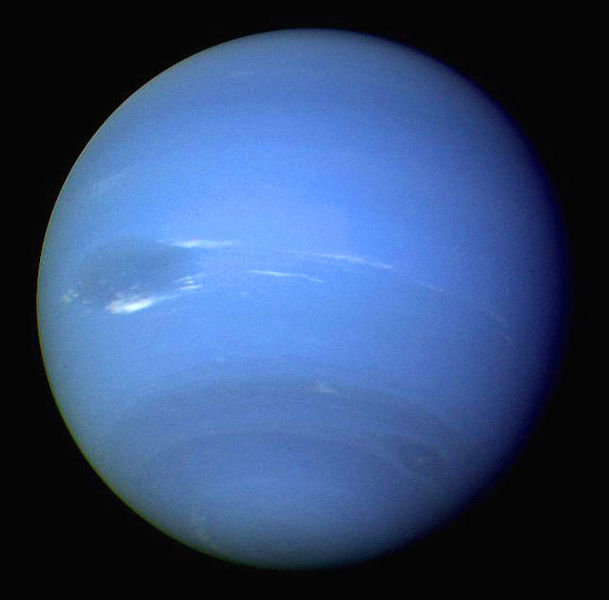
Neptune photographed by Voyager 2. Image credit: NASA/JPL
“The moons and arcs orbit very quickly, so we had to devise a way to follow their motion in order to bring out the details of the system,” he said. “It’s the same reason a sports photographer tracks a running athlete — the athlete stays in focus, but the background blurs.”
The method involved tracking the movement of a white dot that appears over and over again in more than 150 archival Neptune photographs taken by Hubble from 2004 to 2009.
Showalter noticed the white dot about 1 million km (65,400 miles) from Neptune, located between the orbits of the Neptunian moons Larissa and Proteus. Showalter plotted a circular orbit for the moon, which completes one revolution around Neptune every 23 hours.
Showalter should get the “Eagle Eyes” award for 2013!
Source: HubbleSite


No comments:
Post a Comment